


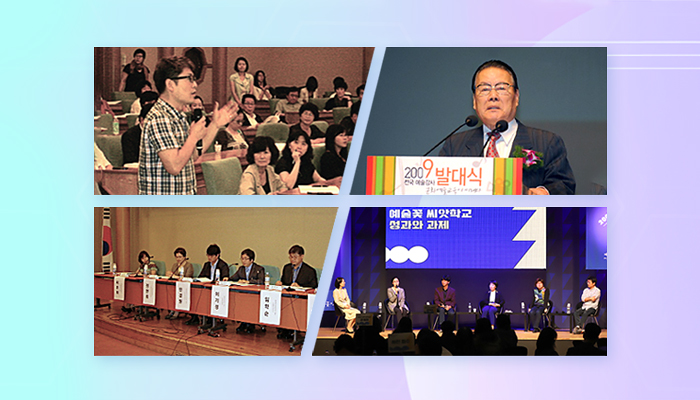
A workshop under the title, <Assessment in Arts Education – Issues & Principles> took place at the Multipurpose Hall of the Artist House in Daehangno on February 21, 2012. The workshop was arranged for the purpose of commemorating the publication of the Korean translation of a book <Assessment in Arts Education> as well as discussing major issues in regard to the assessment in arts education with which the book was dealing in the presence of its authors. It was also to discuss the current situation of each country while reflecting the issues on assessment in current Korean arts education.
Two authors of the book, Professor Philip Taylor the Director of the Program in Educational Theatre in New York University (USA) and Professor Christina Hong the Former Assistant Dean of the Creative Industries Faculty in Queensland University of Technology (Australia), were invited to the workshop. Kim Dae-won a Senior Educational Researcher at the National Curriculum Division in Ministry of Education, Science, and Technology; Park Ji-young a Korean Traditional Music Educator at Korea Arts & Culture Education Service; and Baek Ryeong a Researcher at Institute of Arts & Cultural Management in Kyung Hee University were on the panel. The discussion was moderated by Professor Kim Sunah the Dean of Applied Art Education in Hangyang University.
Professor Taylor introduced NCLB(No Child Left Behind) Act in 2011 and its current status, which was the background of the book <Assessment in Arts Education>. He added that the assessment in arts education is a complicated process composed of both linear (qualitative) assessment and circular (quantitative) assessment.


There were some educators who opposed to the application of assessment standard in arts education. Professor Hong asked to them how we could set up the range of learning and produce ‘a result’ without any standard. She insisted that the assessment is inevitable for education and learning experience in arts education. She stressed that the standard is obviously distinguished from that of the other field of learning, and that the process as well as the result should be considered for assessment in arts education.
These keynote speeches were followed by the panel discussion regarding the assessment in Korean arts education. Kim Dae-won showed the political frame while presenting the current ratio of the arts education in the school curriculum and its assessment standard in detail. And he explained the difference between written assessment and performance assessment while covering the history of the Korean school curriculum. Park Ji-young emphasized the importance of improvement in assessment methodology in arts education to make up for the current immature assessment circumstances.
Baek Ryeong, who had participated in translation work of the book, raised a question that we had lack of discussion about ‘circular structure of the assessment’ that is the situation that the assessment model and index change every year, which results in failure to adequate utilization in Korea. She also mentioned that the Korean word ‘assessment’ includes the measurement of both the process and the result, and insisted that the terms be subdivided to make us have a new understanding of the assessment in arts education.
Since it was a relatively specialized theme, approximately 100 participants were mainly professors, college students, professionals, and arts educators from arts education related organizations. The survey found that most of the participants were content with the objective of the workshop: forming consensus for the assessment in arts education. However, a few of them have mentioned that they need more realistic and clearer assessment methodology. I expect that the coming workshop which is part of <Workshop with Invited Overseas Professionals> will introduce real examples of educational activities in other countries.
Both the workshop and the Korean version of <Assessment in Arts Education (which will be published on March 26, 2012)> will foster a new understanding of assessment in arts education as well as further discussion on circular structure of assessment.
Written by Park Bo-yeon (PR & International Liaison Team)
기사가 좋았다면 눌러주세요!

비밀번호 확인

댓글 남기기