


There has been a question to artist Oum Jeong-soon since when she was young. “What is seeing?” As an artist, her fundamental question has been the subject of her works, which gave birth to the project for the children with visual disability<touching td="" elephant>.
Looking at things in a different way

Oum thinks that those who perceive their own talent are ‘very lucky ones’. She says that her talent which she found by herself is ‘being able to see the world in unusual perspectives’.
“I was so-called ‘weirdo’ when I was young. For example, there was an unused faucet at my house. When I turned it on, the rusted water came out. As I sat and watched the brownish water, its color turned into orange. Then it looked as if it were a stream of orange juice. The logical part of my brain said it was just the rusted water, but the other part said it was orange juice. I kept imagining, ‘It would be awesome if the real orange juice came out of the faucet.’ And finally I said to my friends, ‘The orange juice comes out of the faucet in my house.’ Then they would think of me as a liar or weirdo. And the adults would scold me because of that. All of my imagination was regarded as ‘something wrong’ like that, and was denied and scolded by others, which frustrated and hurt me. ‘Then, how do others look at the world?’ I just wanted to release my suppressed memories through the art. I think it was ‘an attraction’. I just realized that ‘what others say wrong’ was ‘how I see the world’. It was strongly related to the creativity which is necessary to an artist, as you know. It took quite a bit of time until I became aware of my talent.”
Her unusual perspectives have created the project<touching an="" elephant>.
Touching an elephant
The project<touching education="" art="" td="" an="" young.<="" was="" she="" when="" since="" answered="" have="" couldn’t="" oum="" which="" question="" a="" also="" is="" it="" disability.="" visual="" against="" society="" current="" the="" of="" prejudice="" about="" thinking="" while="" seeing?’="" meaning="" real="" ‘what="" question,="" cast="" project="" this="" elephant>,="" touches="" blind=""
“I have two jobs. One is as an artist who shares personal stories. And the other is as a coordinator of<touching art="" td="" an="" was="" have="" which="" question="" a="" is="" it="" disability.="" visual="" the="" of="" this="" elephant>,="" from="" because="" and="" 10="" to="" as="" in="" the="" years="" between="" expression.”

“I have been a volunteer at a school of the blind for three years. The only way to get to know the children was to ask questions. Funny thing is that, however, I could ask them abstract questions such as “What is love? What are friends?” because they were children. Different from the adults, they didn’t add any knowledge to their thoughts, but answered with their innocent opinions. It was hopeful for me that I could have such conversation with them. They sometimes asked me questions as well. Their questions were beyond our imagination. For example, there was a child who did not have any image because she had been blind for her entire life. She asked me, ‘Everybody looks exactly same to me, but why do people say that one is pretty and another is ugly? Why?’ I remember I was at a loss at that time. If she’d been able to see, she wouldn’t have asked such a question. It was ‘a creative question’ including humanities, philosophy, and innocence.”
She says she rather learned a lot from the children during the program. She was inspired by them and came to mature.
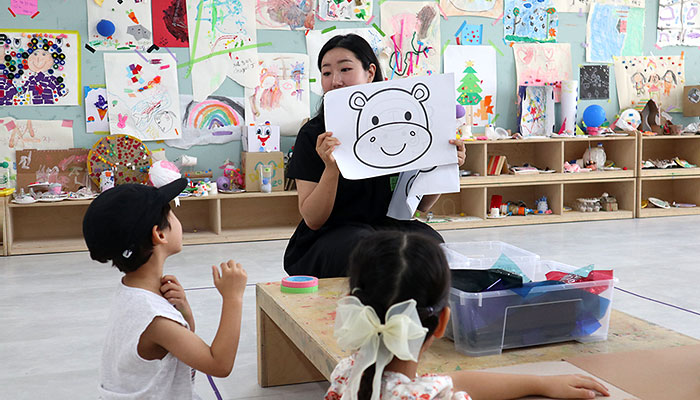
“I felt I solved all the questions that I had had as an artist while working with the children. I wondered, ‘what would happen if I bring the children who were neglected from the art to the world of art?’ This question gave birth to a freshness and creativity. The visual art and the visual disability look ‘incompatible’. But they share the fundamental nature of which contradictory factors clash each other to create something extremely new. I think the art ought to be something like this. I thought my continuous curiosity and passion were helpful to my students because it has created new programs. I try to include everything from our daily life to the art. So I sometimes combine cooking with the art. The art is something we create with our five senses. When I say I am working with the children with disability, people just imagine them only touching and listening something. However, the children say, ‘Don’t push us to touch it because we can’t see it! We can understand perfectly if you could explain it well just like when you do it to the normal people!’ These precious experiences piled up, which kept me thinking, ‘How does the art play a role in life of human being?’ I am grateful that I am able to continue thinking of it. I used to be an autistic artist who just works on art for art. But the encounter with the children with disability itself was an enormous study to me. I came to view the world differently, which changed my personal works as well. She says that creativity is an effort to ask a fundamental question pleasantly, easily, and enjoyably without unnecessities. This ceaseless and earnest question will make her works ingenious.
Written by Hwang So-young
기사가 좋았다면 눌러주세요!
댓글 남기기
-
Hello, yup this paragraph is really fastidious and I have
learned lot of things from it regarding blogging.
thanks.

댓글 남기기
비밀번호 확인

Hello, yup this paragraph is really fastidious and I have
learned lot of things from it regarding blogging.
thanks.