


Encounter Between Film Director Jung Yong-Gi and Future Film-Makers
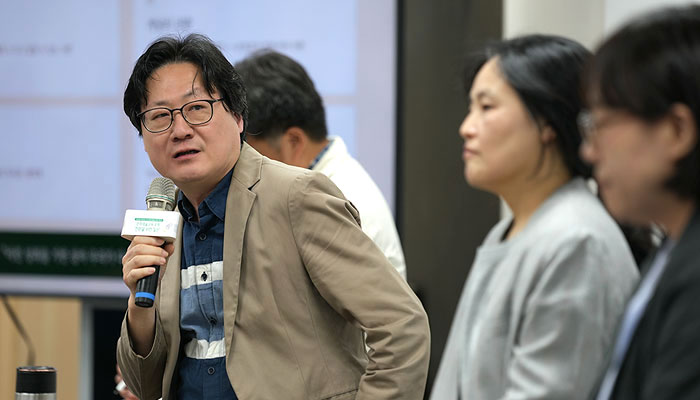
The film director Jung Yong-gi, who gained popularity from movies such as ‘Glory of the Family’ and ‘Descendents of Hong Gil-dong’, met primary, middle and high school students who will be lead Korea’s future film culture and arts. Students who had received awards at the 6th Teen Film Festival also joined the encounter and had the chance to ask Jung questions. Jung told the participants, “Making films will help you express your thoughts and eventually help you realize whatever dream you may have.”

Student: What kind of student were you? When did you start dreaming of becoming a film director?
Jung Yong-gi (hereafter Jung): Since I was young, I really enjoyed watching movies, secretly. When I was graduating primary school, I began imagining myself working with films in my future. At that time, I wanted to become an actor because I didn’t know anything about making films. Then I realized, during my middle and high school years, that it was fun not just to be filmed but also to make films. So I changed my dream, from wanting to become an actor to a director.
Student: When you direct a film, don’t you need to be proactive and outgoing because you need to lead alot of people? I’m a little worried because I am an introvert. Can a shy person like me also become a director?
Jung: Actually, I was also quite timid and shywhen I was young. But because I had to make films, my timid personality became more lively and leader-like. Making a film is about telling my story to the public. It’s another way of communicating with friends and neighbours. I heard that in other countries, people act in plays to overcome their shyness. Whether you act inplays or direct a film, it all involves expressing your inner emotions. So I think it’s a good way of overcoming teenage blues – sort of hitting two birds with one stone.
Student: What do you do when you want to film a particular scene but others disagree?
Jung: Film staff usually respect the opinions of the director and help out. Sometimes, though, differences arise. I would explain the scene in detail to the actors or the staff andtry to convince them. We listen to each other, come to a compromise and then start filming. If the conflict is big and we can’t come to an agreement, we film the scene both ways and then pick one after the film is finished.
 Student: Most kids like cartoons and animation films. Do you remember any cartoons or animation films that inspired you when you were young?
Jung: These days, I think the borderline between animations and films is getting obscure. Look at Avatar. I saw and read alot of cartoons in my younger days. They all stimulated my imagination, even now. Also, typical feature films give alot of inspiration to animation. Actually, they all influence each other across genres.
Student: You always need new material when you make films, right? How do you get your ideas and material?
Jung: You can find material for movies everywhere, all around you. Depending on how you look at that object, you can come up with endless ideas. Most people, when they see a red apple, will simply think, ‘It looks delicious’ but Newton came up with his Law on Universal Gravitation. If you look carefully, anyone can think differently about something or some event, and come up with interesting perspectives. Likewise, if you think interestingly, you can makeinteresting movies.
Student: How do you collect information for your movies?
Jung: I read alot of books I find on the internet. If we need more detail, then we form teams and discuss in groups to go into the specifics. Long time ago, before we had internet, I would go to the library and spend the entire day looking for various material. One of the biggest rolesof a junior staffer is to look into piles of books and material, make photocopies and bring them to the office. One time, we needed photos to cast an actress, so we went to the National Library, borrowed and copied about 100 magazines.

Student: Which genre do you think will succeed commercially in the future?
Jung: There is a certain trend when making films. At one time, thrillers may be in, and at another, action. Sometime comedy. It changes. But that doesn’t mean only one genre exists. At any given time, all genres naturally co-exist. It’s up to the director to make the public emphasize with that particular genre. Rather than trying to fit into a particular genre, it’s better to make a story that’s enjoyed by the public, and that will eventually
become the trend.
Student: Where should experimental films and non-mainstream films aim for?
Jung: The important thing is the different ways of looking at an object. Innovative visuals usually come from differences in perspective. Just as a photographer interprets, through the frame, an object in a novel way, you need to think about how you’re going to approach your object.
Student: What do you think are the benefits of teenagers making films?
Jung: During the process of making a film, you get to formyour own language and way of communicating with others. I think film-making is good for teens developing their dreams, even if he or she does something else later on in life.
기사가 좋았다면 눌러주세요!
기사가 좋았다면 눌러주세요!
좋아요
0
비밀번호 확인

댓글 남기기